

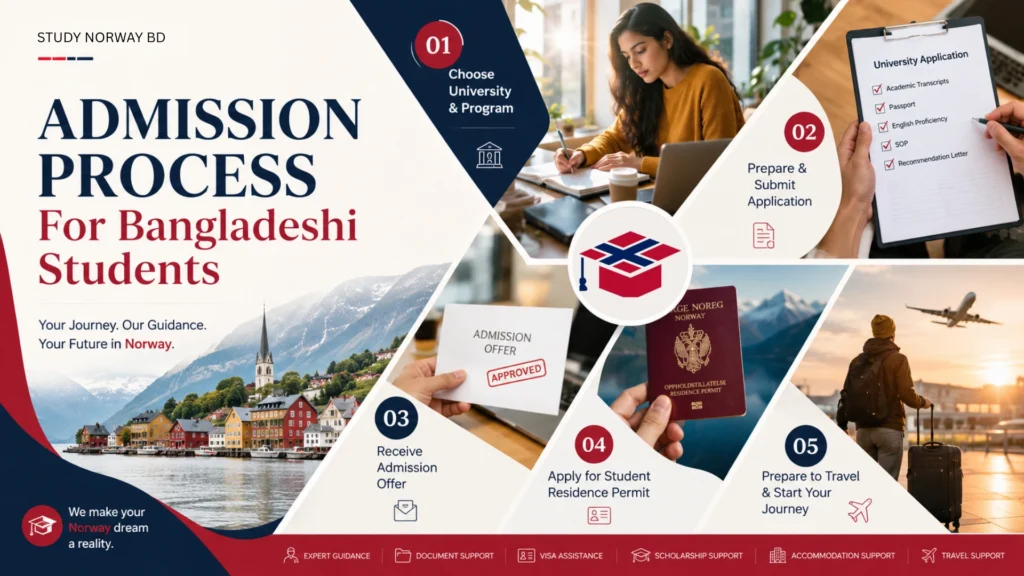

Studying in Norway begins with a well-planned university admission process. Whether you are applying for a bachelor’s or master’s degree, understanding each step helps you prepare the right documents, meet university requirements, and submit a strong application on time.
This guide explains the complete admission process for Bangladeshi students, from choosing the right university and checking eligibility to receiving an admission offer and preparing for your move to Norway. It also provides practical tips to help you avoid common mistakes and make informed decisions throughout your application journey.
Before starting your application, it’s helpful to understand the overall admission journey. While specific requirements may vary across Norwegian universities and study programmes, most Bangladeshi students follow the same general process, from selecting a university to beginning their studies in Norway.
| Step | Admission Stage |
|---|---|
| 1 | Choose a University and Study Programme |
| 2 | Check Admission Eligibility |
| 3 | Meet English Language Requirements |
| 4 | Prepare Required Documents |
| 5 | Submit Your University Application |
| 6 | Receive and Accept the Admission Offer |
| 7 | Apply for a Student Residence Permit |
| 8 | Arrange Accommodation and Travel |
| 9 | Start Your Studies in Norway |
Before applying to a Norwegian university, you should confirm that you meet the academic and language requirements for your chosen programme. Admission criteria vary between universities and degree levels, so always review the specific requirements published by your preferred institution.
For most bachelor’s programmes, a Bangladeshi Higher Secondary Certificate (HSC) alone is generally not sufficient for direct admission. Many universities require additional higher education or qualifications that meet the Norwegian general admission requirements.
Before applying, carefully review the university’s admission policy to understand the academic qualifications accepted for your chosen programme.
Applicants for master’s programmes typically need:
Some universities may also require a minimum GPA or additional subject-specific qualifications.
Most English-taught programmes require applicants to demonstrate English language proficiency through an approved language test.
Commonly accepted tests include:
Minimum score requirements vary by university and programme.
Read our complete guide: Language Requirements for Studying in Norway
Depending on the programme, universities may also request:
Important: Always review the official programme page before applying, as admission requirements may change between academic years.
Applying to a Norwegian university involves several important stages. Following the correct admission process can help you prepare stronger applications, avoid common mistakes, and meet university deadlines. Below is a step-by-step guide designed specifically for Bangladeshi students planning to study in Norway.
Start by researching accredited Norwegian universities and selecting a programme that matches your academic background, career goals, and interests. Compare factors such as programme content, admission requirements, tuition fees, scholarships, location, and future career opportunities before making your decision.
Before applying, consider:
Helpful Resource: Explore our Universities in Norway guide to compare institutions and study programmes.
Once you’ve selected your preferred programme, carefully review the admission requirements published by the university. Requirements vary between institutions, so never assume all universities follow the same criteria.
Typically, universities evaluate:
Meeting the minimum requirements does not always guarantee admission, particularly for competitive programmes.
Collect all required documents well before the application deadline. Preparing accurate and complete documentation reduces delays and improves the quality of your application.
Commonly required documents include:
Tip: Double-check document formats, validity dates, and university-specific requirements before uploading your application.
Most Norwegian universities accept online applications through their official application portals. Complete every section carefully, upload the required documents, and submit your application before the published deadline.
Before clicking Submit, make sure you have:
Missing deadlines or incomplete applications may affect your chances of admission.
After reviewing applications, universities notify successful applicants by issuing either a conditional or unconditional admission offer.
Once you receive your offer:
After accepting your admission offer, you can begin planning for your arrival in Norway. This typically includes applying for your student residence permit, arranging accommodation, organizing finances, purchasing travel tickets, and completing any university pre-arrival requirements.
Preparing the correct documents is an essential part of the admission process. Although document requirements vary between Norwegian universities and study programmes, most Bangladeshi students are asked to submit the following documents when applying for admission.
Note: Always check the official admission requirements of your chosen university, as additional documents may be required for certain programmes.
Valid Passport: A passport that remains valid throughout your application process and planned travel period.
Academic Certificates & Transcripts: Official academic certificates and transcripts from your previous educational institutions. Universities may require certified English translations if the original documents are issued in another language.
English Language Test Results: Proof of English language proficiency, such as IELTS Academic, TOEFL iBT, PTE Academic, or another accepted qualification, as required by the university.
Statement of Purpose (SOP): A well-written Statement of Purpose explaining your academic background, study goals, career aspirations, and reasons for choosing the programme and university.
Curriculum Vitae (CV): An updated CV highlighting your education, skills, work experience, research activities, internships, certifications, and achievements relevant to your application.
Letters of Recommendation (If Required): Academic or professional recommendation letters requested by some universities, particularly for master’s and research-based programmes.
Portfolio or Research Proposal (Programme Specific): Applicants to design, architecture, fine arts, or research programmes may need to submit a portfolio or research proposal demonstrating their skills or academic interests.
Certified Document Translations: If your academic documents are not in English or Norwegian, universities may require certified translations prepared by an authorized translator.
Planning your application early gives you more time to prepare your documents, meet university deadlines, and complete your student residence permit process without unnecessary stress. While application periods vary by university and programme, the timeline below reflects the typical admission cycle for international students planning to study in Norway.
Important: Admission deadlines vary by university, programme, and intake. Always confirm the latest dates on your chosen university’s official website.
| Timeline | What You Should Do |
|---|---|
| 6-12 Months Before Intake | Research universities, compare programmes, check eligibility, and prepare for English language tests if required. |
| 4-8 Months Before Intake | Gather academic documents, write your Statement of Purpose (SOP), prepare your CV, and request recommendation letters. |
| Application Period | Submit your university application before the official deadline with all required supporting documents. |
| After Application Submission | Monitor your application status and respond promptly if the university requests additional information or documents. |
| Admission Decision | Review your admission offer carefully and accept it within the deadline provided by the university. |
| After Receiving the Offer | Apply for your student residence permit, arrange accommodation, prepare your finances, and plan your travel to Norway. |
| Before Departure | Book your flight, organize essential documents, and complete any university pre-arrival requirements before traveling. |
To stay on schedule, we recommend completing these tasks as early as possible:
Even well-qualified students can experience delays or admission challenges due to avoidable mistakes during the application process. Understanding these common issues can help you submit a stronger application and improve your chances of receiving an admission offer.
Each Norwegian university and study programme has its own admission criteria. Applying without reviewing the specific academic qualifications, prerequisite subjects, or language requirements may result in an incomplete or unsuccessful application.
Best Practice: Always read the official programme requirements before preparing your application.
Norwegian universities follow strict admission deadlines, and late applications are rarely accepted. Waiting until the last minute may also leave insufficient time to collect required documents or resolve technical issues.
Best Practice: Prepare your application several months in advance and submit it well before the deadline.
Missing transcripts, expired passports, incorrect file formats, or unsigned documents are common reasons for application delays.
Before submitting, carefully verify that every required document has been uploaded in the correct format and language.
Many students assume their previous education automatically satisfies English language requirements. However, universities may require approved English proficiency test scores unless an official exemption applies.
Always check which language qualifications are accepted for your chosen programme.
A Statement of Purpose should clearly explain your academic background, career goals, and reasons for selecting the programme. Generic or copied statements may weaken your application.
Tailor your SOP to each university and demonstrate why you are a suitable candidate.
Receiving an admission offer is only one part of your study abroad journey. Delaying your student residence permit application may affect your travel plans and arrival before the semester begins.
Begin preparing your financial documents, accommodation arrangements, and required paperwork as soon as you accept your admission offer.
Receiving an admission offer from a Norwegian university is a significant milestone, but there are still several important steps to complete before beginning your studies. Careful planning at this stage will help you meet immigration requirements, prepare financially, and arrive in Norway with confidence.
Read your admission letter carefully and review any conditions attached to your offer. Some universities may require you to confirm your acceptance before a specific deadline or submit additional documents before your admission becomes final.
Always follow the instructions provided by your university to avoid losing your place.
Most non-EU/EEA students must obtain a student residence permit before traveling to Norway. The application generally requires your admission letter, proof of financial support, passport, and other supporting documents specified by the Norwegian Directorate of Immigration (UDI).
Because processing times can vary, begin your application as soon as possible after accepting your admission offer.
Before departure, prepare a realistic financial plan that includes:
You should also understand the financial documentation required for your student residence permit application.
Need help planning your budget? Visit our Scholarship & Financial Assistance page to explore scholarships, tuition fees, and financial requirements: Scholarship & Financial Assistance
Finding suitable accommodation before arriving in Norway can make your transition much smoother. Depending on your university and city, you may choose student housing or private accommodation.
Apply early, as accommodation options can become limited before the start of each semester.
Find out how our Accommodation Support services can help you secure suitable student housing before arriving in Norway: Accommodation Support
Once your residence permit has been approved, you can begin arranging your journey to Norway.
Before departure, remember to:
Explore our Travel Assistance Services to learn how to prepare for your departure, arrival, and student life in Norway: Travel Assistance Guide
After arriving in Norway, complete the registration steps required by your university. Depending on your institution and study programme, this may include:
Completing these tasks on time will help you start your studies without unnecessary delays.
Applying to a university in Norway involves more than simply submitting an application. From selecting the right programme to preparing documents and understanding admission requirements, every stage requires careful planning and attention to detail.
At Study Norway BD, we provide guidance throughout the admission journey to help Bangladeshi students understand the application process, prepare the required documents, and make informed decisions before applying to Norwegian universities.
Whether you are planning to pursue a bachelor’s or master’s degree, our team is here to support you with practical information, personalized guidance, and step-by-step assistance based on your academic goals.
1. University & Programme Selection: We help you compare universities, understand programme requirements, evaluate your academic qualifications, and identify study options that match your educational background and future career goals.
2. Application & Document Guidance: Receive guidance on preparing important admission documents, including academic transcripts, Statements of Purpose (SOP), Curriculum Vitae (CV), recommendation letters, and other programme-specific requirements before submitting your application.
3. Admission Requirements Guidance: Our advisors explain university admission criteria, English language requirements, application deadlines, and supporting documents so you understand what is required before applying.
4. Application Planning: We help you organize your admission timeline, monitor important deadlines, and prepare your application well in advance to reduce last-minute stress.
5. Next-Step Preparation: After receiving your admission offer, we provide guidance on the next stages of your journey, including student residence permit preparation, accommodation planning, financial readiness, and travel arrangements.
If you’re planning to study in Norway and need guidance with university admission, our advisors are here to help you understand the process, prepare your application, and plan your next steps with confidence.
Find answers to the most common questions about the admission process for Bangladeshi students planning to study in Norway.
Block # F, House # 61(1st Floor), Flat # A, 1 Rd 8, Banani, Dhaka-1213
Sat - Thu : 10:00 AM to 07:00 PM

